
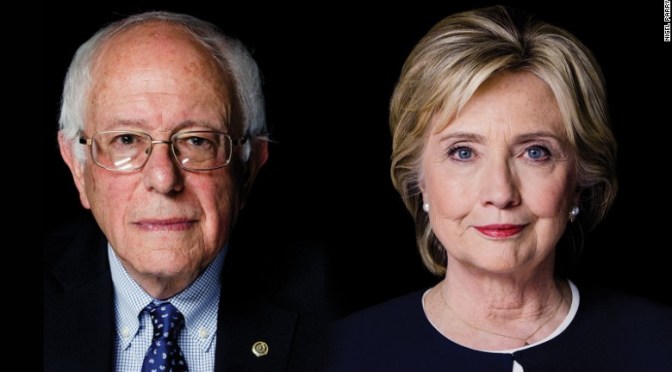
Few things make me angrier than being condescended to or patronized. Arguments and disagreements don’t bother me because I enjoy debating and I always try (though I admit that I do not always succeed) to keep an open mind; being patronized is different, and is sure to get under my skin. I have encountered a LOT of condescension this election cycle – more than I can ever remember experiencing before – and almost all of it has come from one side: the supporters of former Secretary of State Hillary Clinton. From Rolling Stone Magazine’s official endorsement of the Secretary last month to New York Times columnist and Liberal icon Paul Krugman, and to many others both within and outside of the Clinton Campaign, Bernie Sanders supporters, such as myself, are being branded as naïve idealists who don’t know what we’re doing. At best they treat us as unrealistic dreamers with good intentions, and at worst as either rampant sexists or unwitting dupes of some anti-Clinton conspiracy. But regardless of which insulting way these Hillary supporters are branding our support for Senator Sanders, the message is consistent: Hillary supporters ‘admire’ our idealism, but we are blind and must listen to them and support Hillary because they know what is best for us and for the nation.
I am a proud registered Democrat, and this November I will vote for the Democratic nominee regardless of whether it is my personal choice of Bernie, or if it is Hillary, but the arrogance of so many Hillary supporters towards Bernie’s supporters is making it harder and harder for me to have even a teaspoon’s worth of enthusiasm for her. Hillary does not seem to be running on an optimistic message, but instead on a cynical one, claiming that Bernie would be unelectable and, if/once she wins the Democratic nomination, that she is a far better choice than Republican frontrunner Donald Trump or his chief rival for the Grand Old Party’s nomination, Texas Senator Ted Cruz. That argument is logical, and Hillary is light years better than any Republican candidate, let alone the two clowns Trump and Cruz, but logic is not a great way to win elections, and it doesn’t bring people to the polls; we have a lot of evidence for that and we don’t need to look back very far.
In 2008 then Senator Barack Obama beat both Clinton and eventually Senator John McCain to win the presidency running on a message of hope and a change from the dreadful George W. Bush Administration. In the general election, Obama received 70 million popular votes (the most any candidate has received in US history), beating McCain by 10 million votes. In 2012, now President Obama had a lot of achievements that Liberals were excited about, but the only way to make sure that those achievements were not overturned was to help Obama win a second-term and defeat former Governor Mitt Romney. President Obama was reelected, but he received 5 million fewer votes than in 2008, winning 65 to 60 million. People want to vote for a candidate who they can get excited about, and while I believe that Hillary Clinton is amazingly intelligent, hardworking, and competent, none of that is very exciting for me.
The key example that Wenner and others like him consistently point to as the one that taught them the limits of idealism is the 1972 presidential election between incumbent President Richard Nixon, a Republican, and North Dakota Senator George McGovern for the Democrats. McGovern and his anti-Vietnam War platform excited many young Democrats, and because the 1968 election had been close, those young Democrats believed that they could beat Nixon with McGovern just four-years later. But those idealistic Democrats who believed that McGovern might win were proved shockingly wrong and were devastated when Nixon won reelection in one of the largest landslides in history, winning 49 of 50 states, getting 47 million popular votes to 29 million for McGovern (60.7% of the vote, and a victory of 18 million votes, which are both records that have not been equalled since, not even by Ronald Reagan in his own massive landslide over former VP Walter Mondale). Wenner, Krugman, and others like them believe that they learned a valuable lesson in 1972 about the kind of candidates that can win elections in America; I believe that they learned the wrong lesson.
It seems obvious to point this out, but 2016 is not 1972 and Bernie Sanders is not McGovern. Our country has seen different realignments and dealignments of political Parties from the 1790s to today, and 1972 was a huge realigning election. Most southern states had been staunchly Democratic from before the Civil War through the midpoint of the 20th century, but things had begun to change with Civil Rights. The Democratic Party expanded beyond just the South with Woodrow Wilson, and then when the New Deal Coalition formed around Franklin D. Roosevelt, it brought large amounts of northern Liberals and Blacks into the Party, and led to an uncomfortable alliance between the new arrivals and the old south. Racist whites had been able to keep the Democratic Party from getting too invested in Civil Rights, but the coalition began to fray as the Party naturally moved in that direction anyway, and when Lyndon B. Johnson signed the Voting Rights Act of 1965, he figured it would be the final nail in the coffin of the ‘Solid South,’ being a large part of the Democratic Party. After signing the bill, he said ‘We just lost the south for a generation,’ and he was correct. But leaving the Democratic Party did not mean instantly joining the Republican Party, which many southerners still viewed with deep suspicion, so in 1968 the Solid South ran its own pro-segregation candidate in Alabama Governor George Wallace. Nixon won that close ’68 election against Wallace and Democratic Vice President Hubert H. Humphrey, and had the south not defected from the Democratic Party, it is likely that Nixon would have lost. By 1972 the Solid South had indeed found a new home in the Republican Party, and their addition en masse greatly strengthened the Republican Party and weakened the Democrats, and while from 1932-1964 the Democrats had won every presidential election except for the popular war hero Dwight Eisenhower’s wins in 1952 and ’56, the Republican Party would win every presidential election from 1968-1988 except for Jimmy Carter’s win in 1976 (which was only possible due to voter anger over Watergate, Nixon’s resignation, and Ford’s pardon of Nixon, and even with all of that, the election was still close), with almost all the victories coming in gigantic landslides.
The south giving the Republican Party an era of dominance of the White House makes 1972 a poor comparison to 2016 as there is little evidence right now for an ongoing realignment. Bernie’s also a far better candidate today than McGovern was in ‘72. New technology and a well-run organization have gotten Bernie’s message and platform out to people who were either ignored or marginalized in 1972. Bernie’s also not running against an (oddly in retrospect) a popular incumbent, and if he wins the nomination, he would be running against either Trump or Cruz, neither of whom is as strong a candidate as Nixon in ‘72. These comparisons constitute a false choice designed to justify opposition to Bernie, and while I am a Bernie supporter I will readily admit there are legitimate reasons for someone to have doubts about him or to support someone else, but making an inaccurate connection between Bernie and McGovern, and 2016 and 1972 shouldn’t really qualify.
The condescension of the Clinton Campaign and its attempts to casually paint Bernie as a risky choice for either the Party or the nation should be beneath it. Providing weak and inaccurate analogies in order to marginalize Bernie and his supporters is hurting the Party, since it is unlikely to gain any votes for the Secretary or weaken Bernie’s Campaign, while it simultaneously engenders bitterness between supporters of the candidates who are going to have to coalesce in order to defeat the Republicans in November. Patronizing Bernie’s voters reeks of the kind of cynicism that turns people away from politics, and makes it harder to accomplish the kind of things that Liberals and Democrats both want to get done. Pushing people to throw up their hands in disgust and tune out the entire political process is a bad strategy for those who want to show that government can be useful and can do good; it is a victory for those who want to discredit government and democracy in general. Condescension feeds cynicism and leads to feelings of hopelessness, and good things are not accomplished by withdrawing into anger and despair: it is optimism and a sense of the possible that produces positive results. So stop talking down to us and telling us why we’re wrong or foolish to support Bernie, stop using ‘idealism,’ as a synonym for naïve, and tell us why you believe we should support Hillary, and we’ll tell you why we feel that you should support Bernie. If you want to have a productive conversation with us as equals and not wayward children, you’ll find us ready partners.
 The Progressive Take