Category Archives: Congressional elections

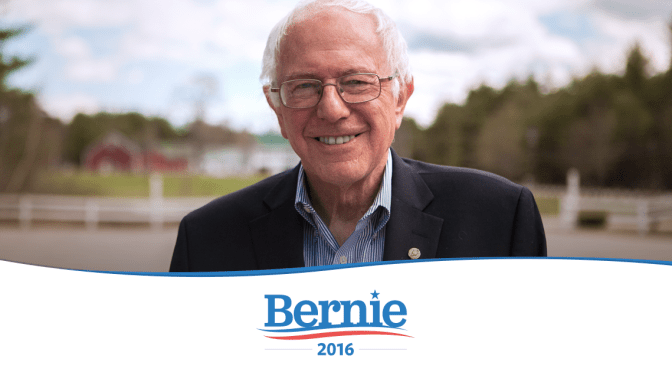
Bernie the Revolutionary?

I think it is time for Bernie Sanders to stop speaking of a ‘political revolution.’ I have encountered both fear and cynicism – even by some Liberals – in response to Bernie’s call. But none need fear, for when Senator Sanders speaks of a political revolution, what he really means is simply increased participation and engagement in our political system.

The hard truth is that we the people are largely responsible for the widespread anger that led to the rise of a neo-Fascist demagogue like Donald Trump – our failure to participate in the political system made Trump possible. The presidential election of 2008 is considered a high-turnout election, as it saw a popular candidate in Barack Obama combined with the deeply unpopular George W. Bush Administration, and Obama received almost 70 million popular votes to around 60 million for Republican candidate John McCain, but in reality only 63% of eligible voters cast a ballot. In 2012, now President Obama won reelection by defeating Republican Mitt Romney 65 million to 60 million, but turnout declined to just under 58%. Voter turnout in mid-term elections, like those in 2010 and 2014, see even less engagement. Many Republican controlled states (many of which only turned Republican due to the small turnouts of those 2010 and 2014 elections) have engineered highly sophisticated voter-suppression efforts to keep turnout down – and they were aided when the Supreme Court undid much of the Voting Rights Act of 1965 that had been the definitive end to Jim Crow segregation and disenfranchisement of Black voters – but no anti-democratic attempt can fully explain the fact that about 40% of eligible voters stay home every November.

Polls and data have consistently proven that increased voter participation almost always benefits Democratic candidates, and poll after poll has shown that the vast majority of Americans already support most of Bernie’s platform. Americans are with him on getting money out of politics, free public college, universal health care, addressing income inequality, climate change, and a whole host of other issues, and if we can simply get more political participation/engagement, we’ll be able to make the kinds of changes that most of us want to see. Those who stay home are at best passive witnesses of the theft of our democratic republic and at worst accomplices in that theft by a small group of wealthy individuals and corporations who have transformed us into a plutocratic oligarchy. It is perhaps cliché to say that all the people who are fully able to vote and choose not to do so are insulting the Americans who came before us and often died to protect that precious right, but whether the non-voters realize it or not, they are also insulting those who come next, because those future generations must live in the nation and world that we leave them.

When Bernie is talking about a political revolution, he is not speaking of something bloody or new, he is speaking of greater engagement with and participation in the political process of our country. He wants to get as many people involved in our democracy as possible, and any who might say that Bernie’s just being cynical because he knows he would do better if more people were involved should stop to realize what they’re admitting by saying that: that Bernie and his policies are preferred by a majority of Americans, and that the closer to 100% turnout we get, the better Bernie would do.

The real revolution here is to stop thinking of voting as a right and instead view it as our duty as Americans: perhaps the least we can do to show our appreciation for our nation and its past, present, and future.

VOTE! Seriously, VOTE!

Cynicism and apathy in American elections is like a disease. Americans look at congress and are disgusted (if the 8% approval rating is any guide), but too often it seems the response – especially among younger would-be voters – is not to work hard to ‘throw the bums out’ but instead to throw up one’s hands and walk away from elections entirely. Voting is one of the issues that I am most passionate about as, with my knowledge of history, I see it as a long battle to expand the franchise to as many people as possible, with a rearguard action always fighting to restrict access to the polls in order to hold onto power without actually serving the interests of the people. For those who want to restrict voting access, apathy and cynicism are their most deadly weapons and, no matter how many people I encourage to vote, and no matter how intelligent those people are, I often hear, “Why should I even vote, it doesn’t matter anyway!” Well, here are some reasons your vote does matter!

90,682,968 Americans voted in the last midterm elections in 2010. That’s out of an estimated 235 + million eligible American voters, or just under 38% of the eligible population. To contrast that, 53% of American voters cast a ballot in the 2012 presidential elections. The 2010 election cycle may not be a good guide as to what will happen tomorrow, but it is a good baseline because no midterm elections ever come close to matching the slice of the populace that votes in presidential elections. 2010 is also valuable as it was the first election after the Citizens United decision, and it is estimated that over $3.6 billion was spent on campaigns in that cycle, and it’s hard to believe that less has been spent in 2014 than in 2010 (numbers won’t come out until after the elections), and just in using the 2010 numbers, it means that even if YOU don’t value your vote, enough money was spent on the 2010 elections to equal over $40 for each vote cast. You may think your vote is meaningless, but obviously there are people and corporations with a LOT of money who believe otherwise and if they are so willing to part with at least $40 per voter, then they certainly think it has value.

Besides the congressional elections, there are also referendums, governorships, and state legislatures that will be decided tomorrow. Washington D.C, Oregon, and Alaska will all vote on whether to legalize and tax marijuana; Alaska, Arkansas, Nebraska, and South Dakota all have a raise in the state minimum wage on the ballot. Colorado and North Dakota have extremely strict anti-abortion “personhood” laws on the ballot, while here in California medical reform and prisoner reform will be voted on. And if you don’t think your governor matters, consider that in Texas, Rick Perry (for purely political reasons) chose not to expand Medicaid as part of Obamacare and therefore around 1 million Texans who would qualify for Medicaid have been left without any health care. It is very unlikely that Democrat Wendy Davis is going to win tomorrow, meaning that those 1 million Texans living in poverty will continue to struggle without the health care that is available to them, but in your state you might be able to make the difference because you never know how close the election will be. This brings me to another number you should consider when deciding whether to vote or not: 537. That’s the amount of votes that separated George W. Bush and Al Gore in Florida in the 2000 presidential election. Avoiding all conspiracy theories and comments about the election result being stolen for the moment, the fact remains that in an election that saw 105 million Americans cast a ballot, it was less than 550 votes that meant we had President Bush and not President Gore

You really need to go and vote tomorrow, and make sure everyone you know who is eligible votes too! Voting is too precious a right to waste when so many states around the country are making it harder for people to vote, and when so many nations around the world go even further than that. Voting doesn’t solve every problem and your vote tomorrow won’t change everything, but in a nation where Blacks once risked (and often lost) their lives to vote and where it took women over 130-years of struggle to get the franchise, it is not just cynical not to vote, it is cowardly. So get out there and vote, honor our proud democratic tradition, and make the choice to be an active participant in our society and not a spectator