Category Archives: Money in Politics

Can the USA Survive Trump?

The United States is facing the largest threat to its continued existence as one nation-state since the Civil War. This is not hyperbole or exaggeration: I have extensively studied the Civil War and American history as a whole, and we are in dangerous waters. As I see it, the threat is a massive leadership vacuum coming from the Washington and Donald Trump.

The problem with the vacuum is that far too many states, cities, and people are not content to just twist in the wind regarding health care, global warming, and immigration. The American people and their state and city representatives are going to step up and fill that vacuum, leading to a potential clash between state and national power the likes of which have not been seen for well over a century.

Even some Liberals are skeptical of the Trump-Russia connection, but if Vladimir Putin made a wish for the United States when he blew out his birthday candles last October, he’s already gotten most of what he wanted. There has been a massive erosion of faith in the American government, the media and even factual, objective reality as a whole; the USA has largely relinquished the leadership role it has held since the end of World War II and is more isolated than any time since just before the War. Now, with the recent G-20 Summit and Trump’s decision to quit the Paris Climate Accords, the rest of the free world openly mocks us. And most troubling of all going forward, our nation is splitting at the seams as the political, cultural, ideological, and economic ties that have bound our nation together for so long are ripped apart.

And the end of our nation may be coming sooner than later. Donald Trump has less legitimacy and political capital than any president in American history, and it isn’t even that close. We already see individuals, states, and cities rising to fill the leadership vacuum, but I believe the real problem will come to a head soon as a result of 2 potential sequences of events, both involving Trump’s role as Commander-in-chief.

1.) Trump grows angrier and angrier over the increased resistance to his rule and to approval ratings lower than intestinal parasites and he and his advisers decide that military action will cause the American people to line up behind him out of patriotic duty. Now, recent history (Iraq) should show him and his advisers that this approach is flawed in the extreme, but Trump neither knows nor cares about recent history. In 2002, President George W. Bush labeled Iraq, North Korea, and Iran an ‘axis of evil,’ and Iraq, the ‘easiest’ target of the 3 is no longer on the list. That leaves the nuclear-armed North Koreans, and Iran, a nation of 80 million people (for comparison, Iraq had 26 million when we attacked in 2003) that will achieve nuclear arms pretty quickly once we tear up the deal that we – along with the UK, France, China, Russia, and Germany – made with them in 2015. Not only will any pre-emptive US attack on those nations devastate our allies and further isolate us more than Trump already has, but there will be many in our armed forces who will not risk their lives for an aggressive war that will be transparently political. For maybe the first time in American history, those who protest the war at the start or who refuse to fight will be those celebrated as patriots.

2.) The more likely scenario as I see it. Trump grows angrier and angrier over the increased resistance to his rule and to approval ratings lower than genital warts, and he finally decides he can’t ‘allow’ protests anymore (First Amendment be damned), and he orders either the National Guard or regular military to disperse the most high-profile and disruptive protests; he does not order them to use deadly force but to use all force short of lethal. It is again easy to see many refusing to follow such orders, which is the very type of situation at the start of many revolutions throughout history.

When the US faced the greatest crisis in our history, we had an almost perfectly designed leader to handle it in Abraham Lincoln. When the Great Depression threatened to end our democratic republic, we had an almost perfectly designed leader to handle it in Franklin D. Roosevelt. We are now at the precipice of national disaster just as we were in 1860 and 1932, but instead of having Lincoln or FDR, we have an erratic, petty, angry, ignorant, short-sighted, dishonest, and probably mentally ill man standing where those two giants once stood. There is no easy answer for this type of situation in the Constitution: we have to find it our selves, and we must identify, elect, and follow leaders in our states, cities, and towns, because there is a vacuum in Washington right now, and we have to recognize it, and decide whether or not it is fatal to the United States as we know and understand it.
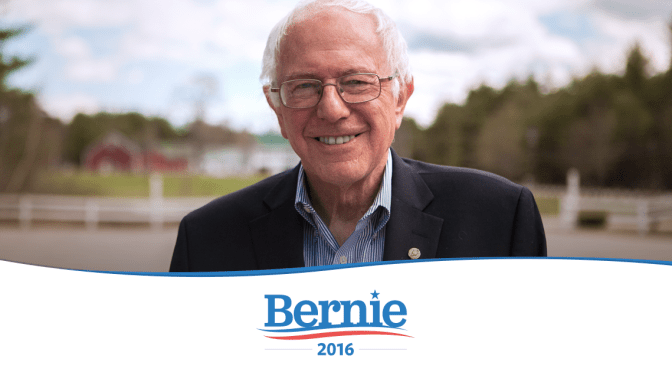
Bernie the Revolutionary?

I think it is time for Bernie Sanders to stop speaking of a ‘political revolution.’ I have encountered both fear and cynicism – even by some Liberals – in response to Bernie’s call. But none need fear, for when Senator Sanders speaks of a political revolution, what he really means is simply increased participation and engagement in our political system.

The hard truth is that we the people are largely responsible for the widespread anger that led to the rise of a neo-Fascist demagogue like Donald Trump – our failure to participate in the political system made Trump possible. The presidential election of 2008 is considered a high-turnout election, as it saw a popular candidate in Barack Obama combined with the deeply unpopular George W. Bush Administration, and Obama received almost 70 million popular votes to around 60 million for Republican candidate John McCain, but in reality only 63% of eligible voters cast a ballot. In 2012, now President Obama won reelection by defeating Republican Mitt Romney 65 million to 60 million, but turnout declined to just under 58%. Voter turnout in mid-term elections, like those in 2010 and 2014, see even less engagement. Many Republican controlled states (many of which only turned Republican due to the small turnouts of those 2010 and 2014 elections) have engineered highly sophisticated voter-suppression efforts to keep turnout down – and they were aided when the Supreme Court undid much of the Voting Rights Act of 1965 that had been the definitive end to Jim Crow segregation and disenfranchisement of Black voters – but no anti-democratic attempt can fully explain the fact that about 40% of eligible voters stay home every November.

Polls and data have consistently proven that increased voter participation almost always benefits Democratic candidates, and poll after poll has shown that the vast majority of Americans already support most of Bernie’s platform. Americans are with him on getting money out of politics, free public college, universal health care, addressing income inequality, climate change, and a whole host of other issues, and if we can simply get more political participation/engagement, we’ll be able to make the kinds of changes that most of us want to see. Those who stay home are at best passive witnesses of the theft of our democratic republic and at worst accomplices in that theft by a small group of wealthy individuals and corporations who have transformed us into a plutocratic oligarchy. It is perhaps cliché to say that all the people who are fully able to vote and choose not to do so are insulting the Americans who came before us and often died to protect that precious right, but whether the non-voters realize it or not, they are also insulting those who come next, because those future generations must live in the nation and world that we leave them.

When Bernie is talking about a political revolution, he is not speaking of something bloody or new, he is speaking of greater engagement with and participation in the political process of our country. He wants to get as many people involved in our democracy as possible, and any who might say that Bernie’s just being cynical because he knows he would do better if more people were involved should stop to realize what they’re admitting by saying that: that Bernie and his policies are preferred by a majority of Americans, and that the closer to 100% turnout we get, the better Bernie would do.

The real revolution here is to stop thinking of voting as a right and instead view it as our duty as Americans: perhaps the least we can do to show our appreciation for our nation and its past, present, and future.

Things We Are Not Supposed to Say #1

In what I plan to be an on-going series, I will ask questions or make statements that it seems society does not want us to ask or say. I don’t have the answers for every one of them, but I think it is important to at least ask the questions anyway and then maybe we’ll find the answers together.

“When is Enough Enough?”

With the US mid-term elections coming up in less than a week, the Koch brothers, Charles and David, have been spending large amounts of money just as they have in every election cycle since the Supreme Court opened up a spigot of dark money in its decision in Citizens United v. Federal Election Commission of 2010. Charles and David Koch spend tens of millions of dollars every election to try to elect politicians who will give Koch Industries (which the brothers inherited, by the way) a free hand to make even more money than they already do. The Kochs doing so much work in order to make more money than they already have seems ridiculous when one considers that each Koch brother independent of the other has over $40 billion. The question I want to ask – but that the media, society, the wealthy, and many politicians don’t seem to want us to ask – is: when is enough wealth enough?

We are raised in this country being taught through school that Capitalism is absolutely good and Socialism is absolutely bad, but that doesn’t go far enough for many in our country; many in the Republican Party have become devoted followers of Ayn Rand and her economic theories. Rand held that there is a moral good in selfishness and greed and that to even question such greed is to invite the benign corporations and rich individuals to leave America to find a home where they are not so underappreciated. With Ayn Rand as their guiding star, many wealthy Conservatives have adopted a self-righteous posture and treat any question or criticism that is posed to them as heresy and a threat to American supremacy.

So why do the Kochs keep spending so much money to elect friendly politicians when they need for absolutely nothing? There is nothing they cannot buy if they desire it, so their attempt to buy the government to make sure Koch Industries can be even more profitable is disgustingly gluttonous. At what dollar amount does it become socially distasteful for an individual or a corporation to just keep piling up as much money and influence as possible? When does greed become unattractive and unworthy of emulation? We as a society have the right to ask these questions even if they scare some in our nation who immediately brand any criticism of the accumulation of wealth as, ‘class warfare,’ and an example of treacherous Socialism. There is no easy answer for how we as a society can deal with the concentration of wealth and power in the hands of so few, but the only way to actually find a solution to this very real problem is to admit it exists, call out greed for what it is, and teach our children to value other things besides just money.