
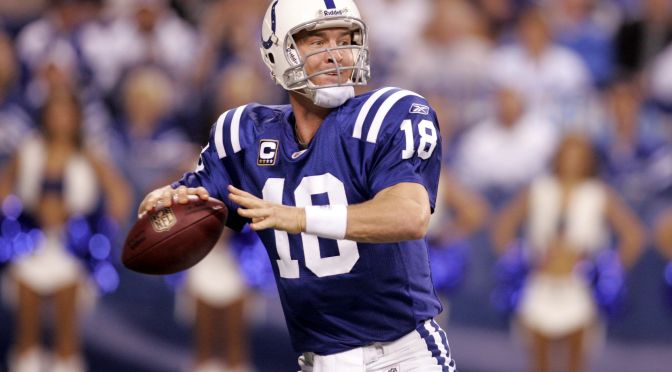
Tomorrow when Denver Broncos quarterback Peyton Manning steps onto the field for Super Bowl 50 (in what could wind up being the last game in his brilliant career) he will be, at age 39, the oldest starting QB in Super Bowl history. Whether it is his last game as a professional or not, he is leaving a legacy has established himself as maybe the greatest QB to ever play the game, and his legacy will be secure regardless of the result. His longevity and his impact on the game have redefined forever what it means to be a franchise quarterback.
But what is a franchise QB in the first place? My own interpretation has been that it is a starting QB who gives his team 10-15 (or more) years of quality play at the most important position in professional sports. A team with a franchise QB is not guaranteed to win Super Bowls, but for at least a decade the team will have a real chance to win championships because its foundation is built on a strong QB. A few players who fit the bill besides the two Super Bowl QBs in Manning and Carolina Panthers QB and almost certain league MVP Cam Newton* are players like Aaron Rodgers, Ben Roethlisberger, Drew Brees, and Eli Manning, all of whom have won Super Bowls; and of course there is Manning’s great rival Tom Brady, who is the only other current QB who has won multiple regular season MVP awards and play in more than one Super Bowl. * Cam is worth his own column, but as he is still early in his career and tomorrow is likely the last game of Peyton’s, Peyton is the topic today.
But there is a more selective group than mere the quarterbacks of today, and that is the best in football history. Excluding QBs who played most or all of their career before the expansion to the 16-game schedule in 1978 (sorry Johnny Unitas, Terry Bradshaw, and Otto Graham, you miss the cut), such a list would include John Elway, Dan Marino, Brett Favre, Steve Young, Manning, Brady, and – usually number one on such lists –Joe Montana. Yet even on that list, Peyton (and Brady) stand far ahead of the rest. Peyton’s combination of sustained success and longevity exceeds all the others on this list. Let’s take a look at the careers of these all-timers:
John Elway:
16 years for Denver Broncos
MVP in 1987
148-82-1 for 64% (He won 12-games or more in a season 4-times. Missed the playoffs 6 times.)
Led team in AV (Approximate Value, which basically means he was the MVP of the team) 7-times.
5 Super Bowls (2-3), winning the championship for 1997-98 and won MVP of XXXIII in 1998.
Dan Marino:
17 years for Miami Dolphins
MVP in 1984
147-93 for 61% (He won 12-or more 3 times. Missed the playoffs 7 times)
Led team in AV 6-times
1 Super Bowl appearance, losing XIX to the San Francisco 49ers in 1984.
Steve Young:
10-years as a starter (8 for 49ers, 2 for Tampa Bay Buccaneers) QB for the 49ers for 8-years
MVP in 1992 and 1994
94-49 for 66% (91-33 for 74% with the 49ers. Won 12-or more 5-times and finished out of the playoffs 3-times, only once with the 49ers)
Led 49ers in AV 6-times
1 Super Bowl win as a starter (1-0) winning the championship for 1994 and MVP of XXIX.
Brett Favre:
19 seasons (16 with the Green Bay Packers, 2 with Minnesota Vikings, and 1 with New York Jets)
MVP in 1995, 1996, and 1997
186-112 for 62% (12 or more wins 6 times, missed the playoffs 7 times)
Led Packers in AV 7-times
2 Super Bowls (1-1) winning the championship for 1996
Joe Montana:
15 seasons (13 with 49ers/starter for 11, 2 with Chiefs)
MVP in 1989 and 1990
117-47 for 71% (12 or more wins 5 times, 2 seasons out of playoffs)
Led 49ers in AV twice
4 Super Bowls (4-0) winning championships for 1981, 84, 88, and 89, and winning MVP in XVI in ’81, XIX in ’84, and XXIV in ‘89
Now take a look at Tom Brady and Peyton Manning:
Tom Brady:
16 seasons with New England Patriots
MVP in 2007 and 2010
172-51 for 77% (12 or more wins 10 times, 1 season out of playoffs)
Led Pats in AV 8 times
6 Super Bowls (4-2) winning championships for 2001, 03, 04, and 2014, and winning MVP for XXXVI in ’01, XXXVIII in ’03, and XLIX in 2014
Peyton Manning:
17 seasons (13 with Indianapolis Colts, 4 with Broncos)
MVP in 2003, 2004, 2008, 2009, and 2013
186-79 for 70% (12 or more wins 12 times, 2 seasons out of playoffs)
Led team in AV 8 times (7 for Colts, 1 for Broncos)
4 Super Bowls (2-2) winning championshps for 2006 with the Colts and 2015 with the Broncos, and winning the MVP for XLI in ’06.
Joe Montana may be the best QB ever, but looking at those stats, the sheer longevity and success of Manning and Brady is unprecedented. They have given their teams over 15-years of not just elite, but legendary play. Yes, the game has slanted more towards passing over the years, and QBs are far more protected today than they were in Joe Montana’s day, but even amongst their own peers who have enjoyed the same benefits that Brady and Manning have, and count among their ranks future Hall of Famers like Drew Brees and Aaron Rodgers, their success is astounding. Brady has had more success in the playoffs with the Patriots than Manning has had with the Colts and Broncos, but the two have met in the playoffs 5 times, with Peyton’s teams winning the series 3-2.
On Sunday, Peyton Manning will play in what is likely to be the last game of his career, and just by stepping on the field he will make history as, not only (as I said before) is he the oldest QB to ever start a game in the Super Bowl, but he will be playing in his 4th Super Bowl and he has had a different head coach in each appearance. If the Broncos win, Peyton will become the first starting QB to win a Super Bowl with more than one team. But while it would be great for him to win a second championship in his last game like his boss John Elway did with the Broncos in 1998, win or lose he has left his mark on the game and it doesn’t take a lot of imagination to argue that he is the greatest quarterback in NFL history. So tomorrow night, no matter who you root for, take a moment to appreciate that we’ll be watching the GOAT take the field for the last time.
Edit: I am not in the habit of changing or adding to pieces once I have published them, but because Super Bowl 50 was played a day after the publication, I am making an exception. The Broncos won the Super Bowl 24-10 due to a historic defensive performance – especially from MVP Von Miller, who had the most dominant game I have ever seen a defensive player have in the big game – and sent Peyton Manning out as a winner.* I believe that this win certifies that which was probably already true before today’s game, which is that Peyton Manning is the greatest quarterback in NFL history. Even before his team’s victory tonight, Peyton already had the most touchdown passes in both single-season and career history, and the most yards in single-season and career history. His victory gave him 200 career wins in the regular season and playoffs combined (one more than Brett Favre’s 199), a 14-13 playoff record, and a 2-2 record in the Super Bowl. He also became the first starting quarterback to win Super Bowls with 2 different teams, and the oldest to win a Super Bowl. I edited his stats to reflect Super Bowl 50 as well.
* As of this update, Peyton Manning has not officially retired, yet watching his greatly limited performance tonight and for the last season and a half, combined with his injury history and the chance to go out a winner (as so few actually do), make it almost certain that we have seen the last game of #18’s career.
 The Progressive Take