Tag Archives: Franklin D. Roosevelt

Can the USA Survive Trump?

The United States is facing the largest threat to its continued existence as one nation-state since the Civil War. This is not hyperbole or exaggeration: I have extensively studied the Civil War and American history as a whole, and we are in dangerous waters. As I see it, the threat is a massive leadership vacuum coming from the Washington and Donald Trump.

The problem with the vacuum is that far too many states, cities, and people are not content to just twist in the wind regarding health care, global warming, and immigration. The American people and their state and city representatives are going to step up and fill that vacuum, leading to a potential clash between state and national power the likes of which have not been seen for well over a century.

Even some Liberals are skeptical of the Trump-Russia connection, but if Vladimir Putin made a wish for the United States when he blew out his birthday candles last October, he’s already gotten most of what he wanted. There has been a massive erosion of faith in the American government, the media and even factual, objective reality as a whole; the USA has largely relinquished the leadership role it has held since the end of World War II and is more isolated than any time since just before the War. Now, with the recent G-20 Summit and Trump’s decision to quit the Paris Climate Accords, the rest of the free world openly mocks us. And most troubling of all going forward, our nation is splitting at the seams as the political, cultural, ideological, and economic ties that have bound our nation together for so long are ripped apart.

And the end of our nation may be coming sooner than later. Donald Trump has less legitimacy and political capital than any president in American history, and it isn’t even that close. We already see individuals, states, and cities rising to fill the leadership vacuum, but I believe the real problem will come to a head soon as a result of 2 potential sequences of events, both involving Trump’s role as Commander-in-chief.

1.) Trump grows angrier and angrier over the increased resistance to his rule and to approval ratings lower than intestinal parasites and he and his advisers decide that military action will cause the American people to line up behind him out of patriotic duty. Now, recent history (Iraq) should show him and his advisers that this approach is flawed in the extreme, but Trump neither knows nor cares about recent history. In 2002, President George W. Bush labeled Iraq, North Korea, and Iran an ‘axis of evil,’ and Iraq, the ‘easiest’ target of the 3 is no longer on the list. That leaves the nuclear-armed North Koreans, and Iran, a nation of 80 million people (for comparison, Iraq had 26 million when we attacked in 2003) that will achieve nuclear arms pretty quickly once we tear up the deal that we – along with the UK, France, China, Russia, and Germany – made with them in 2015. Not only will any pre-emptive US attack on those nations devastate our allies and further isolate us more than Trump already has, but there will be many in our armed forces who will not risk their lives for an aggressive war that will be transparently political. For maybe the first time in American history, those who protest the war at the start or who refuse to fight will be those celebrated as patriots.

2.) The more likely scenario as I see it. Trump grows angrier and angrier over the increased resistance to his rule and to approval ratings lower than genital warts, and he finally decides he can’t ‘allow’ protests anymore (First Amendment be damned), and he orders either the National Guard or regular military to disperse the most high-profile and disruptive protests; he does not order them to use deadly force but to use all force short of lethal. It is again easy to see many refusing to follow such orders, which is the very type of situation at the start of many revolutions throughout history.

When the US faced the greatest crisis in our history, we had an almost perfectly designed leader to handle it in Abraham Lincoln. When the Great Depression threatened to end our democratic republic, we had an almost perfectly designed leader to handle it in Franklin D. Roosevelt. We are now at the precipice of national disaster just as we were in 1860 and 1932, but instead of having Lincoln or FDR, we have an erratic, petty, angry, ignorant, short-sighted, dishonest, and probably mentally ill man standing where those two giants once stood. There is no easy answer for this type of situation in the Constitution: we have to find it our selves, and we must identify, elect, and follow leaders in our states, cities, and towns, because there is a vacuum in Washington right now, and we have to recognize it, and decide whether or not it is fatal to the United States as we know and understand it.

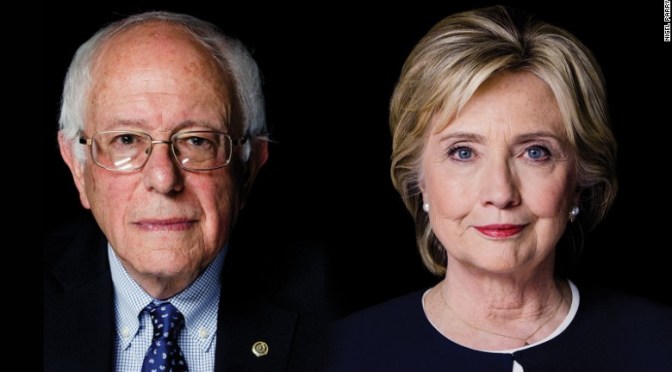
Bernie, Hillary, and the False Choice

Few things make me angrier than being condescended to or patronized. Arguments and disagreements don’t bother me because I enjoy debating and I always try (though I admit that I do not always succeed) to keep an open mind; being patronized is different, and is sure to get under my skin. I have encountered a LOT of condescension this election cycle – more than I can ever remember experiencing before – and almost all of it has come from one side: the supporters of former Secretary of State Hillary Clinton. From Rolling Stone Magazine’s official endorsement of the Secretary last month to New York Times columnist and Liberal icon Paul Krugman, and to many others both within and outside of the Clinton Campaign, Bernie Sanders supporters, such as myself, are being branded as naïve idealists who don’t know what we’re doing. At best they treat us as unrealistic dreamers with good intentions, and at worst as either rampant sexists or unwitting dupes of some anti-Clinton conspiracy. But regardless of which insulting way these Hillary supporters are branding our support for Senator Sanders, the message is consistent: Hillary supporters ‘admire’ our idealism, but we are blind and must listen to them and support Hillary because they know what is best for us and for the nation.

I am a proud registered Democrat, and this November I will vote for the Democratic nominee regardless of whether it is my personal choice of Bernie, or if it is Hillary, but the arrogance of so many Hillary supporters towards Bernie’s supporters is making it harder and harder for me to have even a teaspoon’s worth of enthusiasm for her. Hillary does not seem to be running on an optimistic message, but instead on a cynical one, claiming that Bernie would be unelectable and, if/once she wins the Democratic nomination, that she is a far better choice than Republican frontrunner Donald Trump or his chief rival for the Grand Old Party’s nomination, Texas Senator Ted Cruz. That argument is logical, and Hillary is light years better than any Republican candidate, let alone the two clowns Trump and Cruz, but logic is not a great way to win elections, and it doesn’t bring people to the polls; we have a lot of evidence for that and we don’t need to look back very far.

In 2008 then Senator Barack Obama beat both Clinton and eventually Senator John McCain to win the presidency running on a message of hope and a change from the dreadful George W. Bush Administration. In the general election, Obama received 70 million popular votes (the most any candidate has received in US history), beating McCain by 10 million votes. In 2012, now President Obama had a lot of achievements that Liberals were excited about, but the only way to make sure that those achievements were not overturned was to help Obama win a second-term and defeat former Governor Mitt Romney. President Obama was reelected, but he received 5 million fewer votes than in 2008, winning 65 to 60 million. People want to vote for a candidate who they can get excited about, and while I believe that Hillary Clinton is amazingly intelligent, hardworking, and competent, none of that is very exciting for me.

The key example that Wenner and others like him consistently point to as the one that taught them the limits of idealism is the 1972 presidential election between incumbent President Richard Nixon, a Republican, and North Dakota Senator George McGovern for the Democrats. McGovern and his anti-Vietnam War platform excited many young Democrats, and because the 1968 election had been close, those young Democrats believed that they could beat Nixon with McGovern just four-years later. But those idealistic Democrats who believed that McGovern might win were proved shockingly wrong and were devastated when Nixon won reelection in one of the largest landslides in history, winning 49 of 50 states, getting 47 million popular votes to 29 million for McGovern (60.7% of the vote, and a victory of 18 million votes, which are both records that have not been equalled since, not even by Ronald Reagan in his own massive landslide over former VP Walter Mondale). Wenner, Krugman, and others like them believe that they learned a valuable lesson in 1972 about the kind of candidates that can win elections in America; I believe that they learned the wrong lesson.

It seems obvious to point this out, but 2016 is not 1972 and Bernie Sanders is not McGovern. Our country has seen different realignments and dealignments of political Parties from the 1790s to today, and 1972 was a huge realigning election. Most southern states had been staunchly Democratic from before the Civil War through the midpoint of the 20th century, but things had begun to change with Civil Rights. The Democratic Party expanded beyond just the South with Woodrow Wilson, and then when the New Deal Coalition formed around Franklin D. Roosevelt, it brought large amounts of northern Liberals and Blacks into the Party, and led to an uncomfortable alliance between the new arrivals and the old south. Racist whites had been able to keep the Democratic Party from getting too invested in Civil Rights, but the coalition began to fray as the Party naturally moved in that direction anyway, and when Lyndon B. Johnson signed the Voting Rights Act of 1965, he figured it would be the final nail in the coffin of the ‘Solid South,’ being a large part of the Democratic Party. After signing the bill, he said ‘We just lost the south for a generation,’ and he was correct. But leaving the Democratic Party did not mean instantly joining the Republican Party, which many southerners still viewed with deep suspicion, so in 1968 the Solid South ran its own pro-segregation candidate in Alabama Governor George Wallace. Nixon won that close ’68 election against Wallace and Democratic Vice President Hubert H. Humphrey, and had the south not defected from the Democratic Party, it is likely that Nixon would have lost. By 1972 the Solid South had indeed found a new home in the Republican Party, and their addition en masse greatly strengthened the Republican Party and weakened the Democrats, and while from 1932-1964 the Democrats had won every presidential election except for the popular war hero Dwight Eisenhower’s wins in 1952 and ’56, the Republican Party would win every presidential election from 1968-1988 except for Jimmy Carter’s win in 1976 (which was only possible due to voter anger over Watergate, Nixon’s resignation, and Ford’s pardon of Nixon, and even with all of that, the election was still close), with almost all the victories coming in gigantic landslides.

The south giving the Republican Party an era of dominance of the White House makes 1972 a poor comparison to 2016 as there is little evidence right now for an ongoing realignment. Bernie’s also a far better candidate today than McGovern was in ‘72. New technology and a well-run organization have gotten Bernie’s message and platform out to people who were either ignored or marginalized in 1972. Bernie’s also not running against an (oddly in retrospect) a popular incumbent, and if he wins the nomination, he would be running against either Trump or Cruz, neither of whom is as strong a candidate as Nixon in ‘72. These comparisons constitute a false choice designed to justify opposition to Bernie, and while I am a Bernie supporter I will readily admit there are legitimate reasons for someone to have doubts about him or to support someone else, but making an inaccurate connection between Bernie and McGovern, and 2016 and 1972 shouldn’t really qualify.

The condescension of the Clinton Campaign and its attempts to casually paint Bernie as a risky choice for either the Party or the nation should be beneath it. Providing weak and inaccurate analogies in order to marginalize Bernie and his supporters is hurting the Party, since it is unlikely to gain any votes for the Secretary or weaken Bernie’s Campaign, while it simultaneously engenders bitterness between supporters of the candidates who are going to have to coalesce in order to defeat the Republicans in November. Patronizing Bernie’s voters reeks of the kind of cynicism that turns people away from politics, and makes it harder to accomplish the kind of things that Liberals and Democrats both want to get done. Pushing people to throw up their hands in disgust and tune out the entire political process is a bad strategy for those who want to show that government can be useful and can do good; it is a victory for those who want to discredit government and democracy in general. Condescension feeds cynicism and leads to feelings of hopelessness, and good things are not accomplished by withdrawing into anger and despair: it is optimism and a sense of the possible that produces positive results. So stop talking down to us and telling us why we’re wrong or foolish to support Bernie, stop using ‘idealism,’ as a synonym for naïve, and tell us why you believe we should support Hillary, and we’ll tell you why we feel that you should support Bernie. If you want to have a productive conversation with us as equals and not wayward children, you’ll find us ready partners.

Together We Will Beat Trump

I must admit, I was rooting hard for Donald Trump to win the Republican Primaries and become the Party’s presidential nominee. I’m a Liberal Democrat, and I thought that anything that might make it more likely for the Democratic Party’s nominee to win the presidency was worth cheering on. It was clear to me that Trump was (and is) a ridiculous candidate and completely unworthy of winning a major Party’s presidential nomination, let alone deserving of becoming Commander-in-Chief of the United States, but if the Grand Old Party was incapable of realizing the threat Trump posed to it, then I was happy to sit back and watch Trump do as much damage to the Republican Party as possible before it realized the danger it was in. I savored the schadenfreude of the Republican Party’s collapse until very recently, brushing aside Trump’s increasingly offensive and occasionally horrifying remarks because, in my view, each one made his defeat in November more likely; I scoffed at Trump/Adolf Hitler comparisons as alarmist and inaccurate. I viewed the man as a joke, but now that Trump has victory in sight, my eyes have finally been opened and I am not laughing anymore. In fact, I am begging forgiveness for my failure to see the man for how dangerous he truly is, and to properly appreciate the threat he poses to this country and even the world; Trump’s rise started out as a Republican Party problem, but it has now become an American problem. I am therefore asking all Americans, especially my fellow Liberals who have been silently applauding the moral disintegration of the GOP to realize what is at stake right now and come together to stop Trump, because together is the only way to beat him.

One might wonder how we came to this extremely dangerous place, with Trump – after another dominant performance this past Tuesday – on the cusp of winning the Republican nomination. Our country arrived at this cliff because the Republican National Committee, its chief donors, and its chairman Reince Priebus defended Trump even when it became readily apparent early on that Trump was a demagogue running a campaign dedicated to tearing the United States apart along race, class, gender, and religious lines. The Republican Party froze over an inability to decide what to do about Trump’s rise: should the RNC give the billionaire its full support? Should it marshall its considerable resources and use them to defeat him? Should it rally around another candidate and back him to the hilt? The RNC was either unwilling or unable to decide on any of those options, and instead of taking action, the Party seemed to hope that someone else would handle their ‘problem,’ for them. It hoped to rally around a candidate who could beat Trump, but it just never happened, and with the loss Marco Rubio, seemingly the Party’s last real hope against Trump, the Party has reluctantly realized its predicament. It means that, unless the Republican powers that be (if any remain) contrive to steal the nomination from Trump in Cleveland this July, he will be the nominee of a supposedly great national Party.

What can we do to check Trump’s rise and keep him from attaining the presidency? I believe that the first step requires the kind of hard self-analysis that Americans don’t necessarily love. Introspection is necessary – especially for Liberals – because it reveals that the anger driving Trump’s supporters is real, and that it is not some phantom movement that Trump has created. Trump has given voice to a deep anger that was already there among many people in this country; Trump is turning that anger towards the very worst human impulses and thereby enhancing it, but we as Liberals must acknowledge the validity of that anger to combat him going forward. Anger CAN be useful and can lead to positive ends if there is a mature and capable leader to harness it and wield it skillfully: a great example of such a leader is President Lyndon B. Johnson, who was finally able to use the accumulated righteous anger of Americans to end most vestiges of Jim Crow segregation in the South with the Civil Rights Act of 1964 and the Voting Rights Act of 1965. LBJ could easily have turned that anger against African Americans and other minorities by using coded language and saying things like, “We’re locked in a Cold War against the Soviet Union and Communism, which is now spreading like a weed in Vietnam, and nuclear war may be around the corner. Now is NOT the time to be distracted by a divisive issue on the home front, and those who are pushing for civil rights in such a dangerous time are both unpatriotic and selfish.” Instead, LBJ chose a different course and used that anger to make the greatest contributions to civil rights of any president since Abraham Lincoln, and he did it in spite of his conviction – which has proven correct – that his Democratic Party would lose the south, “for a generation.”

If Trump was a real leader like LBJ, he would say (based on some of his campaign’s themes), “I hear your anger and I share it too, because we have had too many hardworking Americans see their paychecks shrink, or their jobs move overseas, and they have watched opportunities for success disappear in front of their eyes. Let us focus that anger toward making changes and giving the average Americans a real chance to make American great again.” But Donald Trump has not only never said any such things, he does not appear to have even thought them. Instead of bending voter discontent and frustration toward useful goals, Trump is using them as an opportunity to gain power, stirring up the already present anger of his supporters through demagoguery. His message may go all over the place, and he changes his ‘positions,’ not only from day to day, but from speech to speech and even sometimes from sentence to sentence (here against free trade and there for it, etc). But Trump has been frighteningly consistent on who is to blame for our problems and for making America ‘great,’ no longer: illegal immigrants, minorities, and Muslims, are those primarily at fault.

It is Trump’s scapegoating some of the poorest and weakest among us that more than anything else led to me giving a second and third look to some of those Hitler comparisons that have been flying around almost from the moment Trump announced his campaign with a disgusting speech calling all illegal immigrants killers, rapists, and drug dealers – although he did allow that he assumed that ‘some’ were good people…something that I used to find funny but no longer do. The comparison to Hitler has taken on new meaning the last few weeks as the anger and violence at Trump’s rallies has been stirred to new heights, resulting in his audience violently assaulting protesters, the removal or ban of groups of African Americans from attending his events, and a level of fear and danger for the journalists who are covering him. I must confess that I did not initially look too closely at the ‘Trump is like Hitler,’ comments because I have seen so many people described as being like Hitler that the meaning of such criticisms began to fade into meaninglessness. I was also rooting for Trump to win the nomination and destroy the GOP, so I did not care too look too closely for what it might say about me. But I have forced myself to look closer, and I have been frightened by what I have seen.

Donald Trump is appealing to a dark and twisted part of the human psyche, and he is feeding on the hate and anger of his audiences and their resentment of whomever has upset Trump that day, the person he designates as the ‘dangerous other,’ to be hated in that moment. The ‘other,’ may be Black, like President Barack Obama, whom Trump has tried to delegitimize by casting doubt on whether the president was born in Hawaii – as the birth certificate says – or in Kenya, which is what the racist ‘Birther’ movement that Trump once connected himself to believes. The ‘other’ may be a Muslim, and Trump has declared that all members of the religion, which has 1.6 billion adherents worldwide, be banned from entering the USA. The ‘other,’ might be someone with a disability, like New York Times reporter Serge Kovaleski, who Trump openly mocked for having the congenital joint disease, Arthrogryposis (a disease that I was born with, and suffer from myself). It goes on and on, as there is literally no one, no group, and no thought that is too small for Trump to attack; he is the kind of person who would boo at the end of Charles Dickens’s A Christmas Carol because Ebenezer Scrooge shares his wealth with the impoverished Cratchit family instead of stealing Tiny Tim’s crutch, mocking him when he falls over, and leaving with the family’s meager meal.

Trump has been able to say and do almost anything without facing any consequences, but he is far from invincible. We must start with acknowledging that the people are angry, then on understanding the root of that anger, and moving to address its cause and not just control its symptoms. We need to resolve to accept the humanity in all other human beings and not to let Trump use superficial differences to tear us apart. In 1932 the German people chose Hitler and the hatred and fear of the Nazi Party to lead them out of the Great Depression, while in the United States of America we chose the hope and optimism of Franklin D. Roosevelt. There was a short time that it seemed that the American system of government could not survive the Depression and that we would eventually turn to Fascism just as Germany, Italy, and Spain had, but we rejected that choice. We chose FDR and hope, and when he died the USA was the most powerful nation on earth, our economy working at full capacity, and our troops came home to build a better world; we chose hope and we raised America to greatness. Trump is running on hatred and fear, and we have a lot of evidence to show that such a candidate would not, ‘make America great again,’ but would instead be like an alternate version of 1932 where we sided with hatred instead of optimism. We must loudly reject Trumpism with one voice – one voice made out of millions of people of different races, genders, religions, and creeds; in English our national motto is rendered, ‘Out of many, One.’ Splitting that one great American voice into many small and angry ones, with each one attacking the other, is not greatness – it is the cowardly action of a man desperate for power at any price. We have the ability to put our differences aside and work together to stop Donald Trump from ever gaining the presidency, and by rejecting that lying, angry, faithless, hateful, bullying, demagogue, we will prove that America was, will be, and still is great.

Free From Neither Want nor Fear

John Adams said some brilliant things in his long and celebrated career of public service, but my personal favorite is the following quote (which comes from one of the many letters he wrote to his incredible wife Abigail, and which I’ll just paraphrase here): “I must study politics and war so that our sons can have the liberty to study mathematics and philosophy. Our sons must study those things as well as geography, science, business, and agriculture so that their sons can have the freedom to study painting, poetry, music, and architecture.”

One reason I love that particular quote so much is that it is the simplest way to describe what our society is risking by having far too many children in poverty and worrying over whether or not they are going to get to eat today and each day after this one. The most conservative estimates on childhood hunger pegged one-in-six American children as not knowing where their next meal is coming from, while some other sources had as high a figure as one-in-four. I personally never had to worry about if I was going to get enough food, as I grew up in a comfortable middle/upper-middle class family with four younger brothers, and yet in spite of our numbers, we never needed to worry about food – it just wasn’t a concern for us. My parents provided me and my brothers with a safe, warm, and supportive environment that allowed us the freedom ponder the great questions in life – or to just enjoy watching and playing sports and video games – instead of stressing about hunger. It seems today however that far too many children are not growing up in a similar environment to that in which I was raised.

Politicians love to talk about how much they care for our children because it makes them more relatable, but when it comes to actually doing things to improve the lives of those children, too many politicians seem to follow the cynical wisdom of one of the political hacks from the amazing HBO show, “The Wire,” and feel that children should be ignored when it comes to actual policy because “kids don’t vote.” One of the main features of our broken political system has been the almost unbelievable levels of short-term thinking, and it is this kind of thinking that has marginalized the public school system and created a version of ‘separate and unequal,’ for the 21st century. In a good number of cases the rich have abandoned the public school system, and left many schools filled only with children too poor to go anywhere else. And even if the students DO somehow rise above a system seemingly designed to marginalize them and limit their chances to succeed (and more often than not, if those children succeed it is in large part due not only to their parents, but to the heroic actions of teachers) it will be in spite of having to contend with hunger and the fear of hunger on a daily basis. If any children somehow make it through that gauntlet, they often still can’t go to college unless they can get government grants or a scholarship.

How can someone who is legitimately terrified of starvation study mathematics, geography, and science, let alone philosophy, art, poetry, literature, and music? How can someone battling with hunger give as much time or thought to less pressing matters (for what is more pressing than the fear of starvation?) like whether “Hamlet,” or “Richard III” is a better play or how things might have played out if Hitler had been stopped at Munich as his or her fellow classmates? We need to seriously address this problem in our country, from President Obama on down, and the only way to find a real solution is to look at our nation for what it really is and not just what we wish it was; we have the power to make it into the nation we want it to be, but the only way to move towards such a lofty goal is to first address the basic necessities of life. Franklin D. Roosevelt once said that there were four essential freedoms that all human beings on earth should enjoy, and that they are: freedom from fear, freedom of worship, freedom of speech, and freedom from want, and I imagine that those who contend with true want and hunger must also deal with fear.

So can we really expect someone who is staring fear and want in the face every day to compete for grades, scholarships, and eventually jobs with those who have known only comfort and have never once dealt with desperate hunger and fear? I don’t really have the answers on how to fix a fundamental problem that threatens the entire world and not just the United States, but the only way to address hunger both worldwide and here at home is to face it head on and not be afraid to improvise and try new things, and the scary thing is that if we don’t improvise and fix things, we may soon wind up with a generation incapable of addressing such needs and tackling such a tremendous issue.